
When family life changes, uncertainty can feel overwhelming. Structured, professional mediation creates a calm and neutral space where decisions are made together with clarity, respect, and lasting results.
"The mediator helped us think about everyday things we hadn't considered — like who does the school run on rainy days."
— A parent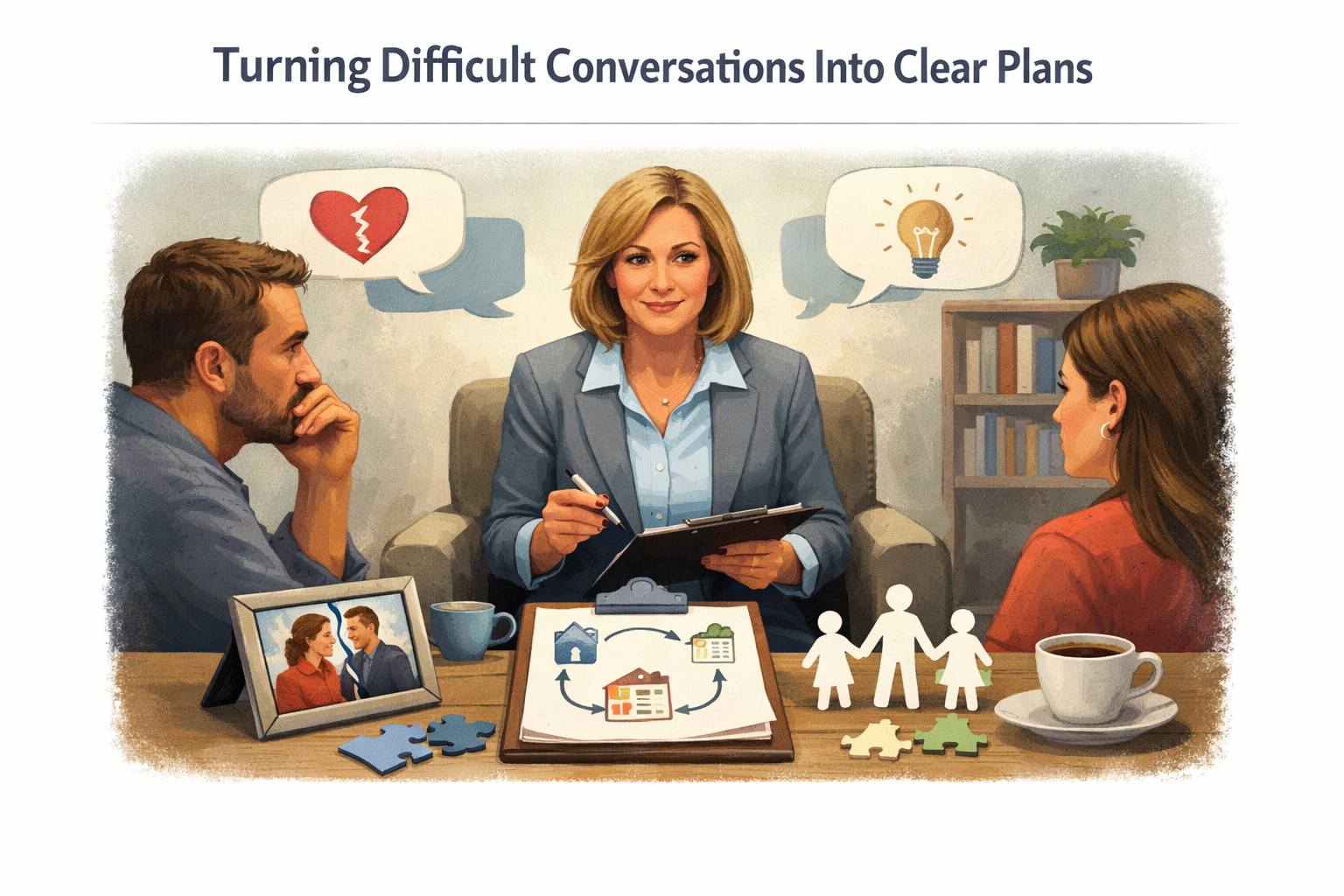
When a family goes through change, everything can start to feel uncertain. Conversations that once felt simple become tense. Decisions that should be practical suddenly carry emotional weight. It can be hard to know where to begin, what to say, or how to move forward without making things worse.
We work with families who are navigating separation, adjusting to new living arrangements, or simply struggling to agree on important matters. The goal is not to revisit the past or assign blame it is to focus on what happens next. What does everyday life need to look like? How can responsibilities be shared fairly? What arrangements will give children stability and reassurance?
By keeping discussions structured and forward-looking, we help turn overwhelming situations into clear, manageable steps. The result is not just a written arrangement, but a workable plan for real life something both people understand, something they have helped to create, and something that reduces stress rather than adding to it.
"Change is rarely easy, but with the right structure and support, it can become a process that leads to clarity, stability, and a calmer path forward for everyone involved."
Our Guiding Principle
When families look for support, they are usually carrying more than paperwork. They carry stress, uncertainty, and frustration that has built up over months or even years. What they need is not complicated legal language or a rigid process that feels cold and impersonal.
Every step is explained in plain, straightforward terms. You will always understand what the process involves, what your options are, and what comes next — without technical language obscuring the path forward.
Every person in the room is given space to speak and be listened to. Even when conversations are difficult, they are managed carefully so that no one feels dismissed, rushed, or overpowered.
Agreements should function smoothly on a Monday morning when the school run is busy, on a Wednesday evening when childcare needs adjusting, and on weekends when routines change. Plans are built around how life actually works.
Decisions made during conflict can have long-term effects on children. Every conversation is guided with children's stability, routines, and emotional wellbeing as the primary priority — not the conflict itself.
Mediation discussions are private. What is said in a session is not normally shared outside the process. This creates the safety needed for honest, productive conversations without the scrutiny of a public legal setting.
The mediator does not take sides or push one outcome over another. Instead, they guide discussion so that both perspectives are fully understood — creating the safety people need to compromise and find lasting solutions.

Knowing what is coming takes some of the uncertainty out of decisions that need to be made. The mediation process follows a clear, structured path from the first exploratory meeting through to a workable, written agreement and aftercare support.
A brief, confidential meeting where mediation is explained, safety and suitability are carefully explored, and any questions are answered. The aim is clarity and information — not pressure. If mediation is appropriate, next steps are discussed.
Where helpful, each person meets the mediator individually to clarify goals, gather thoughts, and prepare. These sessions are private and allow each participant to focus on what matters most to them before joint sessions begin.
The main work of mediation happens here. A structured agenda is set, both sides are heard equally, and sessions proceed at a pace that suits the family — in person, by video, or with separate rooms where needed.
Larger problems are broken into manageable parts children first, then finances, then the future. Options are explored, ideas are tested, and practical realities are carefully checked: handover arrangements, shared costs, and weekly schedules.
Once agreements are reached, they are written in plain English. Both parties review and agree to the draft, which may be refined until it feels right. Where legal documents are needed, a summary is provided for solicitors to formalise.
Arrangements are not set in stone. Ongoing availability for brief follow-up conversations ensures things settle smoothly, and any small adjustments that life requires can be made without reopening formal proceedings.
Balanced guidance, calm and well-managed conversations, and agreements designed to fit the lives you actually live — not an idealised version, but your real routines, responsibilities, and priorities.
Mediation supports a wide range of family situations. It is not limited to separation or divorce — it is appropriate wherever important decisions need to be made cooperatively, and wherever communication has become strained or difficult.
"We were worried about the stress a court case would cause our teenage daughter. Mediation helped us agree on a schooling and holiday routine without the courtroom drama."
— Co-parentMediation is not suitable for every situation. Where there are ongoing safety concerns, uncontrolled substance dependence, coercion, or domestic abuse that cannot be safely managed, mediation will not proceed. Safety is assessed carefully at the outset, and alternative pathways are always explained.

Every family's circumstances are different. The services available cover the full range of decisions that arise when family life changes — from the first exploratory meeting through to specialised support for children, finances, and wider family networks.
A short, private discussion exploring whether mediation is suitable. Safety, suitability, and likely outcomes are all considered. This is a first step, not a commitment — and it clarifies the options available before any decisions are made.
Supports both parties to agree on arrangements for children, finances, and property in a way that reduces future conflict. Issues are divided into manageable parts, and agreements can be turned into formal legal documents if required.
Helps parents agree on where children will live, how time will be shared, decision-making responsibilities, and how special occasions are managed. Emphasis falls on day-to-day needs: school, routines, activities, and practical transitions.
Structured conversations about assets, debts, and future needs — with care and honesty, not pressure. Discussions address affordability, future living costs, and fair division that respects each person's individual circumstances.
When appropriate, child-inclusive techniques allow children's daily experiences and preferences to be heard in a safe, sensitive way. This is not about asking children to decide — it is about understanding what arrangements ease their lives.
Grandparents, step-parents, and extended family members can be part of the conversation where appropriate, either as participants or through separate meetings exploring contact, support, and appropriate boundaries.
Blended family dynamics can be complex — different routines, step-parent roles, and responsibilities across households. Clear, compassionate agreements protect children's stability and respect the reality of new family arrangements.
When court proceedings are being considered, mediation often remains a meaningful and sometimes required first step. Focused sessions map realistic options and provide summaries that solicitors or courts may need if matters proceed.
When families face separation or disputes over children and finances, court proceedings are often assumed to be the only route. Mediation offers a practical, constructive alternative. Understanding the differences helps families make genuinely informed choices.
A parenting plan should read like a weekly diary with flexibility for life's surprises. It is not a legal document full of formal clauses — it is a practical guide for day-to-day life that both parents understand and can actually follow.
The aim is not a perfect arrangement on paper. The aim is an arrangement that holds on a busy Tuesday morning, during a difficult school week, and when unexpected things happen. Agreements that are realistic are agreements that last.
When parents feel heard and have played an active role in shaping solutions, they are far more likely to follow through — and far less likely to return to formal dispute in the future. That continuity is what gives children the stability they need.

Safety is the foundation of every session. Careful assessment happens before mediation begins, and professional safeguards remain in place throughout the entire process — for adults and children alike.
Mediation conversations are treated as private. What is discussed in sessions is not normally shared outside the process and generally cannot be used as evidence in court. These boundaries are explained clearly at the outset.
Confidentiality has defined legal limits. Disclosures suggesting a child is at risk, evidence of serious criminal activity, or threats to life or safety must be passed to appropriate authorities. These exceptions are explained calmly at the start of every process.
Where ongoing domestic abuse, uncontrolled substance dependence, or coercive control prevents safe and equal participation, mediation will not proceed. Safety planning is a core part of assessment, and alternative routes are always outlined clearly.
Where there are safety concerns, separate rooms, shuttle mediation, or alternative formats are recommended. The aim is to maintain a genuinely fair process where both parties can participate without fear or undue pressure.
Mediators combine formal training with extensive practical experience in family contexts. They are skilled in safety assessment, child-inclusive practice, and building workable family agreements. Details of qualifications and accreditation are provided on request.
Children's welfare is the consistent reference point throughout every session. Child-inclusive work is handled by trained practitioners with care and sensitivity. The goal is always to understand and protect children's day-to-day lives and long-term wellbeing.
No arrangement is permanent. Life changes, children grow, and circumstances evolve. Good agreements are ones that can flex when life requires — and support is available to help families navigate those adjustments without starting over.
When people have played an active role in creating an agreement, they are far more likely to understand it, respect it, and maintain it. That sense of ownership significantly reduces the likelihood of disputes being reopened in the future.
Agreements are documented clearly so both parties understand exactly what was decided and why — no ambiguity, no legal jargon.
Brief follow-up conversations are available to check how arrangements are settling and make small adjustments where real-life experience shows things need to change.
Where formal legal documents are needed, a clear summary is provided that solicitors can use to convert the mediated agreement into a binding court order or contract.
When arrangements work and parents communicate well, children benefit from the predictability and emotional security that reduces anxiety and supports healthy development.
A mediated agreement becomes legally binding if both parties choose to convert it into a formal court order or a legally binding contract through solicitors. The mediator provides a clear summary suitable for legal professionals to work from.
If mediation does not reach a full agreement, neither side loses any legal rights. The mediator explains next steps and can provide a record of the MIAM for use with legal advisors or court processes, should that become necessary.
Safety is the first priority. Mediation is not suitable where there are ongoing risks of harm, uncontrolled substance misuse, or where one person cannot participate freely. Safety is carefully checked during the MIAM and alternatives are suggested where mediation is not appropriate.
Solicitors are sometimes consulted between sessions for legal advice outside of mediation. They rarely sit through sessions themselves. Instead, the mediator prepares a plain-English summary that lawyers can review and, if needed, formalise into legal documents.
There is no fixed timeline. Some families reach agreement in a few sessions; others benefit from more time. Progress is kept practical rather than rushed, and the pace is always one that genuinely suits the family involved.
Children are only involved when appropriate, and always through child-inclusive techniques handled by trained practitioners. The aim is to understand the child's daily life and wishes sensitively — not to place any burden of decision-making on them.
Mediation requires willingness from both parties. If one person declines, a MIAM remains helpful to explain all available options. Other routes — solicitors, arbitration, or court — are outlined, and no one is pressured into any particular path.
No. Mediators are strictly neutral. Their role is to ensure both people can be heard and that conversations remain fair, focused, and productive — not to favour any particular outcome or person.
No. Private preparatory meetings are available so each person can speak confidentially about priorities and concerns before any joint sessions begin. This ensures everyone feels prepared and heard before the shared discussions take place.
Plain-English explanations are provided throughout, and language support can be arranged where needed. This may include a professional interpreter, translated written materials, or follow-up summaries in a preferred language. The process is designed to be accessible to all families.
After months of arguing, we reached a clear plan in three sessions. It felt practical, not perfect, but manageable. The mediator helped us think about everyday things we hadn't even considered — like who does the school run on rainy days.
— A parentWe were worried about the stress a court case would cause our teenage daughter. Mediation helped us agree on a schooling and holiday routine without the courtroom drama.
— Co-parentThe mediator explained things in plain language and didn't take anyone's side. That honesty helped us keep talking and, ultimately, settle matters without long legal battles.
— A separated coupleI was nervous at the start, but meeting privately first meant I could explain my concerns properly. We left with a parenting plan that actually made sense for our work schedules.
— Working parent
There is no one-size-fits-all formula. Every family's circumstances are genuinely different, and every case is treated that way. What every family does share is the need for a process that is fair, private, and led by people who listen carefully.
Our approach is built on empathy, neutrality, and a deep understanding of the practicalities of family life. Sessions are structured to allow each person to speak and be heard without interruption — turning emotional conversations into constructive, forward-looking planning.
We also support diverse family structures. Modern families come in many forms — single parents, blended families, grandparents as primary carers, same-sex parents, and extended family arrangements. All are served with the same plain-English explanations, cultural sensitivity, and genuine respect.
Mediators combine formal accreditation with extensive practical experience in family contexts — skilled in safety assessment, child-inclusive practice, and the detail of building workable agreements.
Empathy and neutrality are at the heart of every session. Structure keeps discussions focused and reduces the risk of decisions being driven by anger or confusion rather than practical need.
When children are affected by change, routines, emotional safety, and predictability take priority. Arrangements are tested against real-world scenarios — school runs, bedtimes, weekends — to protect day-to-day life.
Plain-English explanations, cultural and language support, neurodiverse-friendly adjustments, and flexible formats — in person, by video, or evenings — are all part of standard practice, not extras.
School and childcare arrangements, handover times and locations, weekday and weekend scheduling, shared costs, health and special educational needs, holiday and birthday plans, and how important decisions will be made.
A simple list of priorities for children and finances. Any relevant documents — school timetables, benefit arrangements, mortgage or tenancy details — and a realistic willingness to think about workable solutions.
Remote video sessions for those who cannot travel, in-person meetings for those who prefer face-to-face, and evening appointments where schedules allow — all designed to make mediation as accessible as possible.
Change in family life is rarely clean or easy. What helps most is a calm space to talk, someone who listens without judgment, and clear plans that work in everyday life. The aim here is to help families move from anxiety to practical arrangements — routines that fit school runs, sensible plans for weekends and holidays, and straightforward ways of handling shared costs.
Children are always at the heart of this work. When adults have a clear, predictable plan, children feel safer and more secure. That predictability shows up in routines, consistent messages, and a reduction in conflict — even when emotions continue to run high between adults. A simple, agreed structure can be genuinely calming for children, and it frees parents to focus on parenting rather than logistics or ongoing dispute.
Our goal is straightforward: to turn tough conversations into clear plans that work in real life. If you want an approach that prioritises day-to-day functioning, reduces friction, and puts children's wellbeing first, you will find a style here that is practical, compassionate, and focused on outcomes that last.